

A spectacular park known as India-Bangladesh Amity Park has been built in a place named Chhotakhola in Tripura. The latter is a part of the region named Belonia, which is at a distance for 132 km. from Agartola, Chhotakhola is situated very close to the Indo-Bangladesh border. The singular history of the muktijuddho (Liberation War) is closely associated with this park. At the beginning of the liberation war, this region close to Tripura’s border and surrounded by hills was the unwritten address of the Muktibahini. The Awami League leader of Feni, Khaja Ahmed, was primarily responsible for setting up a camp here. He looted the town’s godown, banks etc. in Pak-occupied Feni and crossed ever to Chhotakhola with a huge amount of cash money. At the start, it was a transit camp for refugees. Refugees who came from distant places like Chattagram, Noakhali, Feni, Khagrachori, Brahmanbaria, Comilla were given shelter here in the beginning. When the refugees recovered somewhat from the ordeal, they were sent to Agartola, Meghalaya, Bisalgarh and even to places outside Tripura. From the month of May 1971, Chottakhola turned into a camp of Muktibahini as well, which operated beside the transit camp. The Muktifauz was trained here by the cooperative Indian Army.
Quite some operations were directed and conducted from Chhotakhola. The first guerrilla operation of the Mujibahini was directed from the base camp that had been set up in Chhotkhola. After completing the operations, the freedom fighters used to return to Chhotakhola. Because this specific location was very close to the Dhaka-Chattagram Highway, quite a few attacks were conducted against the armed trucks of the Pakistani Army. During the last phase of the freedom struggle, Chhotakhola turned into a centre of attacks launched by the Pakistani Army. In order to thwart these assaults and conduct counter-attacks, the Muktibahini along with the Indian border force and the Army adopted a strong and determined position here. Besides, there are quite a few burial sites of Muktijodhas who became martyrs. Next to these graves, even Pakistani soldiers were buried. It needs to be noted that bunkers were built in this area and the latter were preserved in the Amity Park because they carried the memories of the war of liberation. Suval Rudra, who was one of the principal organizers had to say the following on the burials of Pakistani soldiers : “These Pakistani soldiers who were killed by members of the Muktibahini inside Bangladesh following operations launched by the Muktibahini were buried here because these very corpses increased the confidence and bravery of the freedom fighters”.
Chhotakhola is thus associated very closely with the memories of the liberation war and it is precisely here that the appropriate India-Bangladesh Amity Park has been built. The aim, evidently, is to preserve these valuable memories. A singular history stands behind this construction and Chhotakhola, the site of remembrance, which is now a prosperous panchayat inside the Rajnagar Bloc.
Sudhan Das was a CPI (M) Assembly legislator of Tripura. He was the visionary behind this India-Bangladesh Amity Park. The history of this park is also old and remarkable. For example, Tripura’s erstwhile Chief Minister, Manik Sarkar, said, “The park’s beginning centres around an ancient mosque”.
On January 2, 1993, CPI(M) leader Sudhan Das went to Chandrapur to raise funds for the party budget. He learnt in Chandrapur that an ancient mosque going back to 400 years was situated in the dense forest. Thereafter he declared, that if the CPI(M) came back to power, this mosque would be renovated.
Every year on December 6 a solidarity fair would be held here. In fact, when the Left Front government was formed in 1993, Sudhan Das proposed that a solidarity fair should be held close to the mosque. And in that very year the Solidarity Fair was organised for the first time. Since then, the Fair is being held every year.
In 2004, the ruling CPI(M) government directed each of its Assembly legislator to build an entertainment centre for the people as well as one park where people could walk in the morning. Further, Sudhan Das decided to build a big park incorporating the area of the ancient mosque in Chandrapur, hills on the sides and lakes. Sudhan Das knew very well that these hills and Chhotakhola village in Chandrapur were layered with memories of the Bangladesh War of Liberation. That is why he named the park ‘War of Liberation’ park. On December 16, 2005, the spokesman of the state CPI(M), Gautam Das, inaugurated the park. He appealed to the Chief Minister, Manik Sarkar, to associate the memory of the Liberation War fought from Chhotakhola with a broader and larger perspective and space. Chief Minister Manik Sarkar, the then Minsiter of Tourism Jiten Chaudhury and Gautam Das took the decision to build a big park in Chhotakhola impregnated with the memories of the Liberation War. The decision was taken to raise this beautiful park on 20 hectares of land and it was decided that it would have a natural waterfall and seven small hills.
The responsibility to build this park was given to the experienced Janardan Roy Chaudhuri who was the Assistant Protector of Wildlife in Trincha Abhayaranya. At the request of the Indian government, an expert committee was formed consisting of four Bangladeshis – they are : Professor of History, Muntassir Mamoon, artist Hashem Khan, architect Mobeswar Hossain and Professor Mesbah Kamal. Their job was to supervise the plan of the park, create its design and engage in other relevant activities. However, Mobeswar Hossain and Mesbah Kamal remained non-active The coordinator’s primary duty was carried out by Shahid Kader Chowdhury. In 2009, the then Foreign Minister of Bangladesh, Deepu Moni, laid the foundation stone of the park.
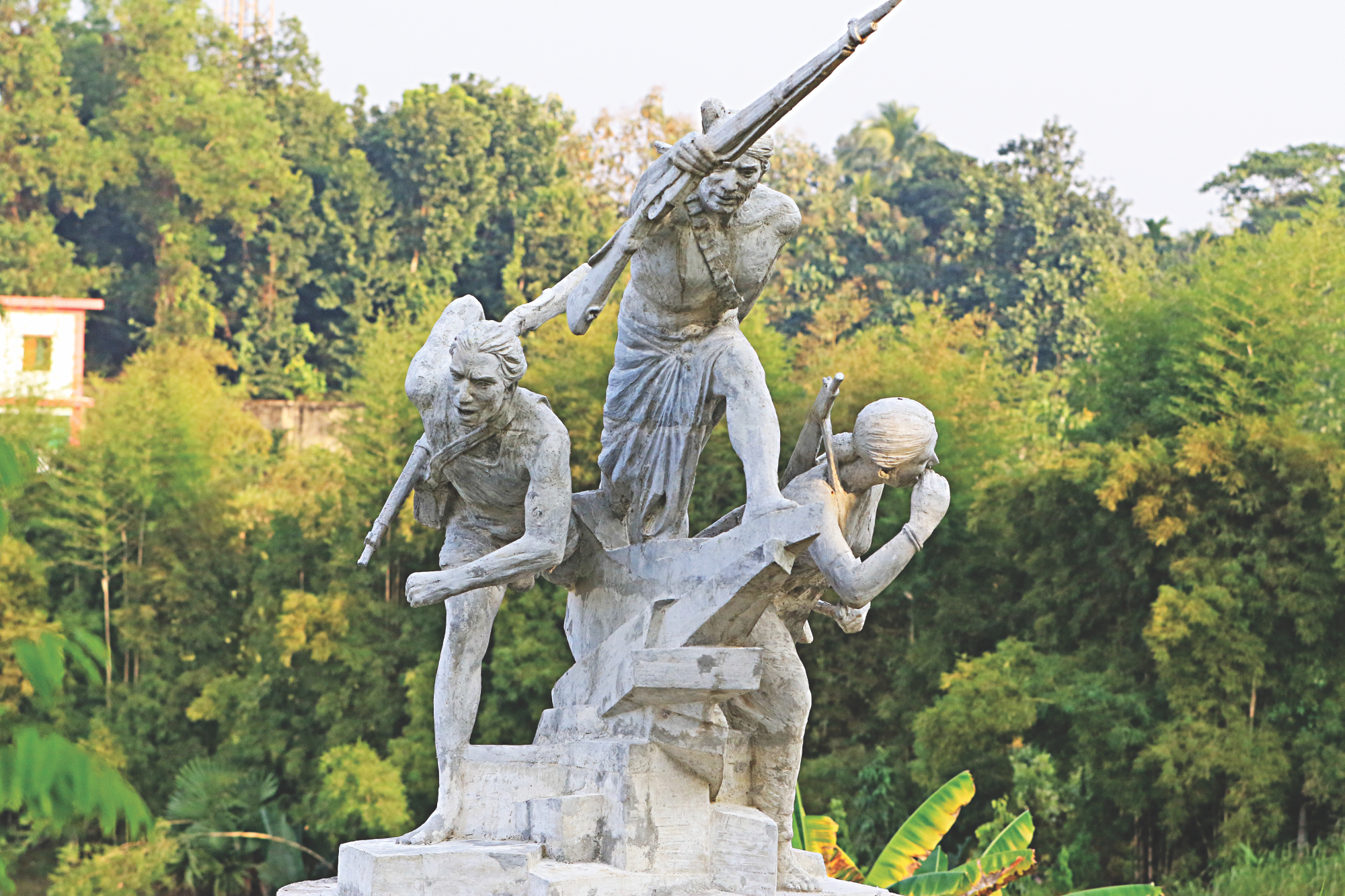
After this the multifarious work of construction began. The park, which has come up in the Jagannathdighi protected forest area is dotted with two beautiful hanging bridges, a memorial in imitatioin of the national memorial at Savar, and some sculptures. It needs to be mentioned that Jagannathdighi is a subdivision in the Belonia region. The beauty of the park has been enhanced by the flowing, natural lakes inside it. Different pictures of the liberation war would be engraved on the hills. The sculpture park based on the liberation war has been established here – courtesy 1971 Genocide-Torture Archive and Museum Trust in Khulna. The creation of the sculpture park began on October 1, 2015. ‘Ganahatya/Genocide 71’ by the famous artist Hashem Khan. ‘Refugee Child’ by Shyamal Chaudhury, 4 sculptures by Tejas Halder and Mahmudul Hasan have been constructed and they adorn the park. Besides, two sculptures – of Bangabandhu Sheik Mujibur Rahman and of Indira Gandhi – have also been accomplished. On the right side of the entry gate, on the foothills of the mountain, a traditional indigenous terracotta has been placed. A Bangladesh Liberation War Museum has also been built inside the park. The 1971 Genocide-Torture Archive and Museum Trust gave all technical help to build this Museum inside the park.
On 16 December 2017, Saturday the day of victory, the park was officially inaugurated after a spell of long and desired waiting. The Chief Minister of Tripura, Manik Sarkar, inaugurated the memory-bound India. Bangladesh Amity Park, which is so intimately linked with the history of Liberation War fought in 1971.
This park layered with memories of the liberation war reminds one of those turbulent days. At the same time, it focuses on the history of cooperation and fellow feeling of the state of Tripura extended in 1971. This park is indeed the new address of tourism for both the countries. It is easy to come to this park from Akhaura and Bibir Bazar in Bangladesh. One could come from Khulna’s Bibir Bazar to Belonia and from there it only takes thirty minutes to reach the Amity Park in Chhotakhola.
Again, one starts from Akhaura, reaches Agartala and from there after crossing Bisalgarh, Sonamura and Nidaya one comes to the destination Chhotakhola. While proceeding on these paths, you encounter extensive green vegetation – rubber, sal, arjun and camphor trees. One can also make a detour and see Sipahizilla, Tripura University, Neermahal or the bison-infested Abhayarany in Trincha or liberation war’s memory-layered Bangladesh Field Hospital.
This Amity park is, on the one hand, the source of inspiration of the people of the world seeking freedom, and, on the other hand, it gives a new dimension to bilateral relations. A new address for tourism.